AI: Help or Threat? Jobs & Work Explained
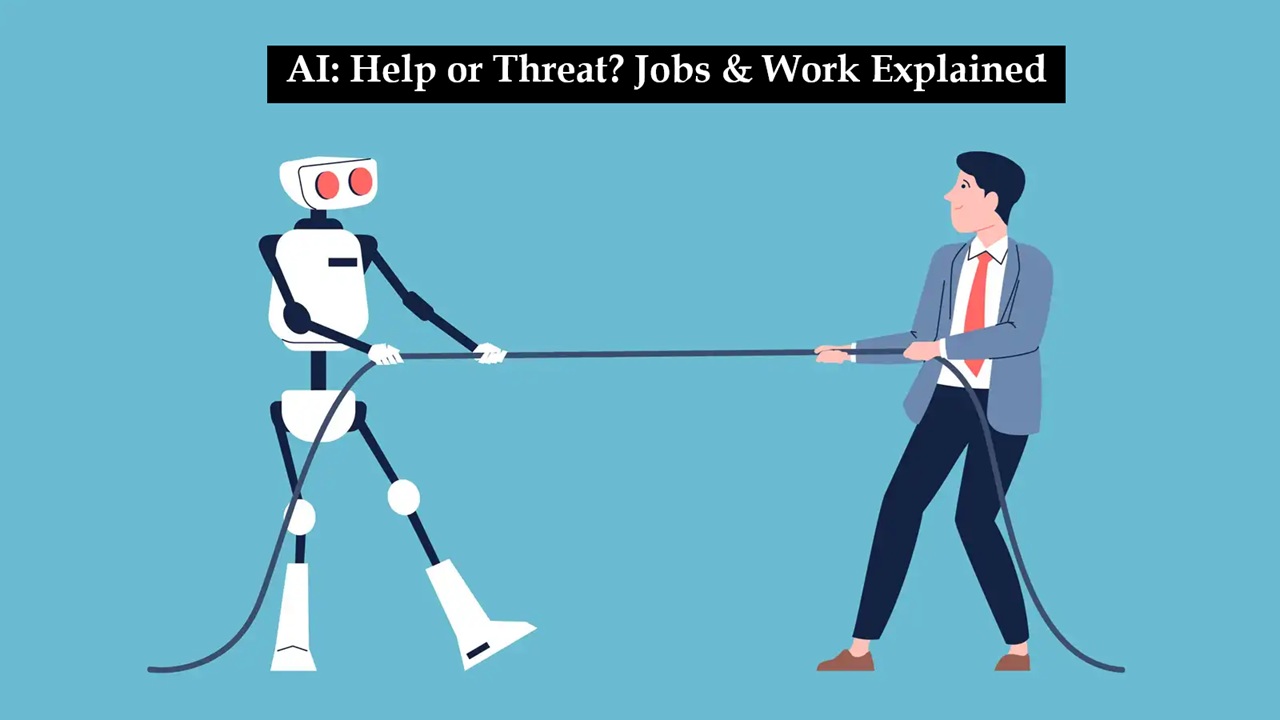
Imagine a world where machines can write reports, design graphics, and even compose music. For some, this is exciting—a glimpse into unprecedented efficiency. For others, it raises a pressing question: will AI take our jobs? Today, artificial intelligence (AI) isn’t just a buzzword; it’s becoming a fundamental part of workplaces and daily life.
In simple terms, AI refers to computer systems designed to perform tasks that typically require human intelligence, such as learning, problem-solving, and decision-making. From smart assistants on our phones to sophisticated algorithms managing global logistics, AI is reshaping the way we work and live.
This article explores the full spectrum of the AI conversation. We’ll examine its benefits, potential risks, and real-world examples. More importantly, we’ll guide readers on using AI responsibly, understanding its ethical implications, and preparing for a future where humans and machines collaborate rather than compete.
Understanding Artificial Intelligence
Artificial intelligence has a rich history that stretches back decades. Early AI experiments in the 1950s focused on simple automation and problem-solving. Over time, advancements in computing power, data availability, and algorithms transformed AI from a theoretical idea into practical tools that impact millions of lives today.
AI can be broadly categorized into three types:
Narrow AI: Specialized AI designed to perform a specific task, like recommending movies or detecting fraud in banking. Most of the AI we encounter today falls into this category.
General AI: A theoretical form of AI capable of performing any intellectual task a human can do. Researchers are still exploring its possibilities.
Generative AI: AI that can create content—text, images, music, or code—based on prompts. Tools like ChatGPT or DALL·E fall into this category.
It’s important to differentiate between AI assistance and AI replacement. Assistance enhances human capabilities, streamlining repetitive or time-consuming tasks. Replacement, on the other hand, takes over roles entirely, which is where fears of job displacement arise.
By understanding these distinctions, we can see AI not as a monolithic threat but as a spectrum of tools, each with unique applications and implications. Recognizing this helps businesses and individuals make informed decisions about adoption, ethics, and skill development in an AI-driven world.
How AI Helps Us: Productivity, Innovation, and Everyday Life
AI’s positive impact is visible in nearly every sector. In the workplace, automation handles repetitive tasks, allowing employees to focus on creativity, problem-solving, and strategic thinking. For instance, AI-powered data analysis reduces hours spent on spreadsheets, while AI-driven customer service chatbots provide instant support, freeing human agents to manage complex issues.
In healthcare, AI helps doctors detect diseases earlier by analyzing imaging data more accurately than humans alone. Educational platforms use AI to create personalized learning experiences, ensuring students progress at their own pace. Even content creation benefits—AI can draft reports, generate designs, or suggest marketing strategies, acting as a collaborator rather than a replacement.
Consider research from McKinsey: companies using AI for process automation report up to 20% productivity gains, while employees spend less time on mundane tasks. A real-world example is a marketing agency leveraging AI tools to generate initial campaign drafts. The team then refines these drafts, saving dozens of hours weekly while maintaining originality.
AI also enriches daily life. Smart assistants organize schedules, recommend meals, or help manage household energy consumption. Music streaming apps predict listener preferences, and navigation tools suggest optimal routes in real time.
These examples demonstrate that AI often augments human abilities rather than stealing them. By embracing AI thoughtfully, both businesses and individuals can enjoy greater efficiency, creativity, and innovation while reducing burnout and mundane workload.
Does AI Steal Our Work? Understanding the Risks
The rise of AI has sparked widespread concern about job displacement. While automation can eliminate repetitive tasks, it rarely eradicates entire professions. Instead, AI transforms work, shifting the focus from routine execution to oversight, creativity, and decision-making.
Industries most affected include content writing, graphic design, customer service, and data entry. For instance, AI can generate news drafts, but editors are still essential for accuracy, style, and context. In design, AI tools create templates, but human designers provide originality and brand consistency.
Ethical concerns also come into play. Who owns AI-generated content? How do we prevent biases embedded in algorithms from influencing critical decisions? Intellectual property, originality, and fairness are now central to AI discussions. A real-life example: a customer service company replaced routine query responses with AI, but complex complaints still required human judgment. This hybrid approach minimized job loss while enhancing efficiency.
Statistics reveal nuance: a World Economic Forum report predicts that by 2027, AI may displace 85 million jobs, but create 97 million new roles requiring advanced analytical and interpersonal skills.
The takeaway is clear: AI doesn’t simply “steal” work; it reshapes the labor landscape, emphasizing adaptability and upskilling. Recognizing which tasks AI excels at—and where humans remain indispensable—is key to navigating this transition responsibly.
Striking the Balance: How to Use AI Without Losing Control
The optimal approach is human-AI collaboration. AI can augment performance, but humans remain essential for judgment, empathy, and creativity. Think of AI as a co-pilot rather than a replacement driver.
Certain skills remain AI-resistant: complex problem-solving, interpersonal communication, strategic thinking, and ethical decision-making. Focusing on these areas ensures humans maintain relevance, even as technology evolves.
Businesses can integrate AI responsibly by adopting a hybrid workflow, automating repetitive tasks while keeping humans in critical decision-making roles. For example, AI can draft reports, but humans review for accuracy and nuance. Individuals benefit from upskilling, learning AI tools while developing complementary human skills.
Awareness and control are key. Set clear boundaries for AI usage, continuously monitor outputs for errors or biases, and ensure transparency in decision-making. By doing so, AI becomes a tool for empowerment, not a source of dependency or risk.
AI Ethics, Regulations, and the Future of Work
AI governance is evolving rapidly. Countries worldwide are introducing regulations to ensure AI systems operate safely, ethically, and transparently. From the European Union’s AI Act to emerging guidelines in the US and Asia, policymakers are addressing concerns about privacy, bias, and accountability.
Debates on copyright and data ownership have intensified with generative AI. Who owns content created by machines? Clear policies are essential to prevent misuse and protect creators’ rights.
Looking ahead, trends suggest greater human oversight of AI systems, particularly in high-stakes industries like healthcare, law, and finance. Generative AI will continue to advance, but ethical deployment will determine whether society benefits or risks unintended consequences.
Balancing innovation with accountability is crucial. AI promises efficiency and creativity, but without rules and ethics, its potential can be misused. Businesses and individuals who adopt AI responsibly today will shape a safer, more productive future.
Myths and Misconceptions About AI
AI often faces exaggerated fears. Many believe AI will take all jobs or develop consciousness. In reality, AI lacks awareness or emotions; it follows programmed patterns and learns from data.
Another misconception: AI creates work independently. While AI can generate content, human guidance ensures quality and relevance. For example, AI-generated marketing copy still requires human review for tone, branding, and strategy.
Experts emphasize that understanding AI reduces fear. McKinsey research highlights that humans will continue to manage tasks requiring creativity, empathy, and judgment, which AI cannot replicate. By demystifying AI, we can prevent panic, misuse, and unrealistic expectations.
Ultimately, informed engagement—learning what AI can and cannot do—is the best defense against myths.
Conclusion: AI as a Tool, Not a Threat
AI is not here to replace humans but to empower them. From enhancing workplace productivity to improving everyday life, AI offers enormous benefits when applied responsibly. The key is collaboration: humans provide judgment, ethics, and creativity, while AI handles repetitive, data-driven, or complex analytical tasks.
Upskilling, awareness of ethical concerns, and responsible adoption are essential to navigate this new era. While AI transforms the labor market, it also opens opportunities for innovation and growth, allowing humans to focus on what machines cannot replicate.
The call to action is clear: embrace AI as an ally, adapt your skills, and harness technology to augment—not replace—human capabilities. With thoughtful integration, AI can be a tool that amplifies our potential rather than a threat to our livelihoods.